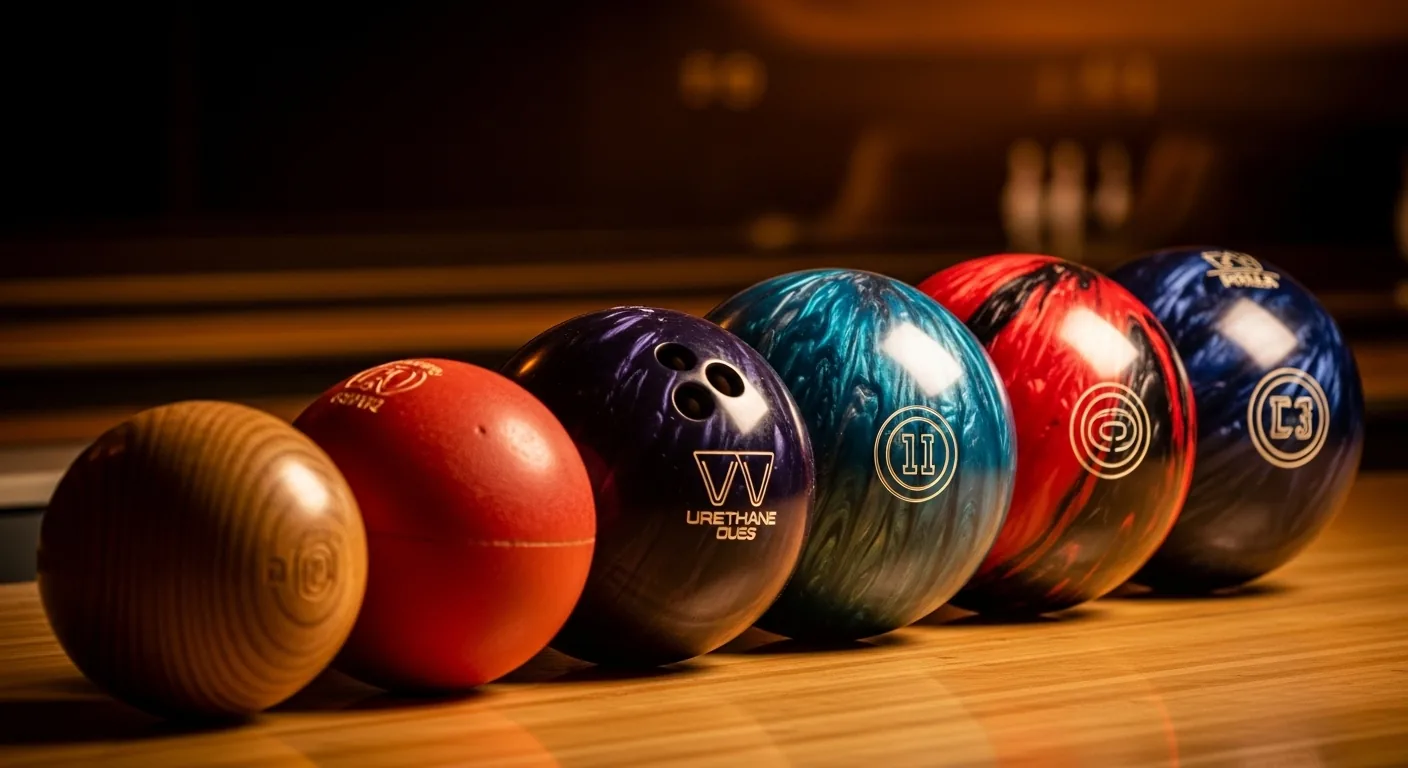
Wooden balls
Early bowling balls were made of wood, famously the extremely dense hardwood lignum vitae. Wood balls were heavy, hard, and had essentially no hook potential by modern standards. The game was about accuracy and straight delivery — the rich world of coverstock-driven hook simply didn't exist yet.
The rubber era
The introduction of hard rubber balls in the early twentieth century was a leap in durability and consistency. Rubber dominated for decades and remains a nostalgic symbol of mid-century bowling. Still, rubber's smooth, hard surface limited friction — the hook was modest and controlled compared to what was coming.
Plastic / polyester
Polyester (plastic) balls arrived and offered an affordable, durable, very smooth ball. Plastic hooks very little, which is exactly why it survives today as the ideal spare ball material — it goes where you aim. But for strike balls, the limited friction left bowlers wanting more reaction.
The urethane revolution
Urethane changed everything. Softer and grippier than plastic, urethane balls hooked noticeably more and gave bowlers real, controllable reaction for the first time. Urethane's smooth, predictable motion was so effective it reshaped scoring and strategy — and it has enjoyed a major modern revival precisely because of that control on demanding patterns.
Reactive resin and beyond
Then came reactive resin — porous, tacky coverstocks that grip the lane far more aggressively than urethane, producing the big, angular hooks of the modern game. Combined with sophisticated, computer-designed cores (symmetric and asymmetric weight blocks tuned by RG and differential), reactive resin made ball motion a science. The arms race of covers and cores continues today, and it's why modern equipment can do things wooden-ball bowlers could never have imagined.
Pins, lanes, and pinsetters
Equipment evolution wasn't just the ball. Pins gained a protective plastic coating; lanes moved from pure maple and pine to synthetic surfaces that wear more evenly; and the automatic pinsetter — covered in the modern era — mechanized what had been done by human pinsetters, transforming bowling from a labor-dependent pastime into a scalable commercial entertainment.