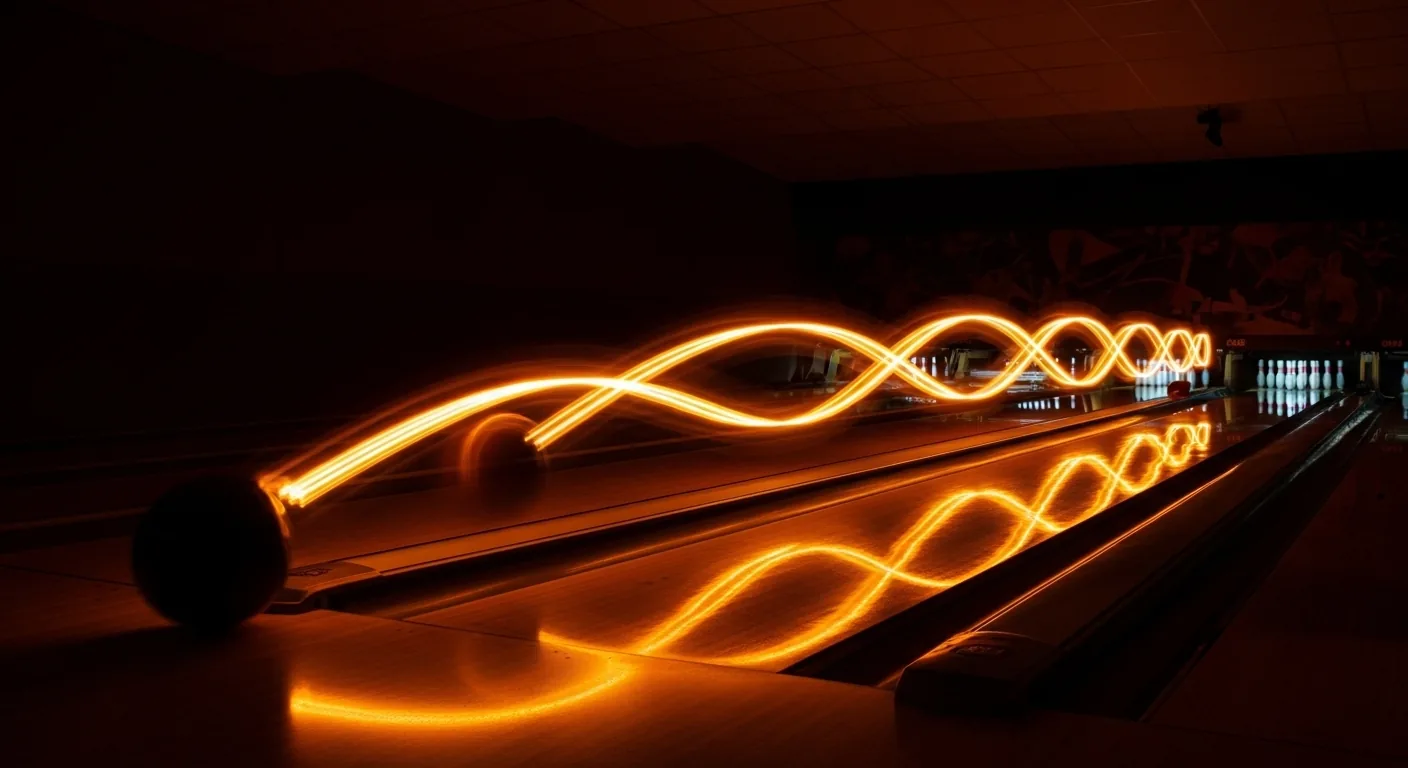
The three phases
A thrown ball moves through three distinct phases down the 60-foot lane:
- Skid: in the oily front part of the lane, the ball slides with little change of direction, conserving energy.
- Hook: as it reaches the drier midlane and back end, friction increases, the ball's rotation grips, and it changes direction toward the pocket.
- Roll: finally the ball stops sliding and rolls forward end-over-end, driving through the pins.
A good shot has these phases in the right proportion: enough skid to save energy, a strong defined hook at the right spot, and enough roll left to carry the pins.
Friction and oil
The oil pattern controls where skid ends and hook begins. More oil = longer skid, later hook. Less oil = earlier grip, earlier hook. This is why the same ball behaves differently lane to lane and even frame to frame as the oil transitions. The interaction of the ball's surface with the oil is the whole ballgame.
The coverstock's job
The coverstock — the outer shell — is the single biggest factor in ball reaction because it's what actually touches the lane. Reactive resin coverstocks are slightly porous and tacky, gripping the lane far more than smooth plastic. Surface texture (polished vs. sanded) tunes how early and how much the ball grips. Two balls with identical cores can behave completely differently based on coverstock and surface.
The core's job
Inside the ball, the core (or weight block) shapes how the ball revs up and transitions. Symmetric cores produce smoother, more predictable motion; asymmetric cores produce sharper, more angular breakpoints. The core's properties — described by numbers like RG (radius of gyration) and differential — determine how quickly the ball starts rolling and how strong the hook shape is. Full detail lives in the bowling balls deep-dive.
Energy transfer to the pins
The goal of all this is entry angle and retained energy at the pocket. A ball that enters the pocket at a good angle, still carrying forward roll, sets off the ideal pin chain reaction — the ball drives through the 1-3-5-9 (for a righty) while deflected pins clear the rest. A ball that's spent its energy early, or enters too straight, leaves corner pins. This is why 'carry' can feel mysterious: it's the sum of speed, revs, entry angle and energy, all arriving together.